Home / Kitchen Guides / Cabinetry Guide
Measure book — guide, joinery and storage

Choosing kitchen cabinetry: doors, finishes and hardware

Cabinetry is the largest single order in most kitchen renovations and the part of the room your hands are on every day. It is also decided in a particular order — what the boxes are made of, then the door, then the finish over it, then the colour, then how you open it. Begin with a colour and you will eventually discover the finish you wanted is not made in it.
This guide walks the sequence as it runs at the design table, and describes how each choice shows itself a year in: fingerprints along an opening edge, a chipped corner near the bin, a door that has quietly stopped lining up with its neighbour.
A kitchen wall featuring muted green shaker-style cabinetry, glossy white subway tiles, pale benchtops, metallic handles and displayed food items.
Reference photograph: a shaker door in a mid-tone colour with metallic pulls — a profile, finish and handle chosen as three separate decisions, in that order.
Field note — sequence
Six decisions. Only the first two are genuinely hard to undo.
01

The order the decisions are made

Cabinetry is specified from the inside out. Each step narrows the one after it: a finish that flatters a shaker door will not necessarily suit a flat slab, and a colour freely available in laminate may not exist in a sprayed finish without a custom match. Working in order keeps the choices open for as long as possible.

01  Carcass and construction — board, edging, backs and legs; the part nobody photographs.

02  Door profile — slab, shaker or routed; this sets the formality of the room.

03  Finish type — laminate, melamine, two-pack polyurethane or timber veneer.

04  Colour depth — how dark you can go before every mark announces itself.

05  Handle or handleless — pulls, a routed J-pull, a rail, or a push-catch face.

06  Hinges and runners — the only components in the kitchen with a duty cycle.

Steps one and two are fixed once the joinery is cut. Handles can be swapped in an afternoon years later, which is worth remembering when the budget is tight. Where a standard cabinet cannot resolve a corner, a chimney breast or a sloping bayside floor, the answer is Custom Cabinetry rather than a compromise on the door.
02

Start with what you cannot see

A door is chosen in a showroom; a carcass is chosen on paper, and it decides whether the kitchen is still square in ten years. Board thickness and the way cut edges are sealed determine how a cabinet behaves under the sink, beside the dishwasher and above the cooktop, where steam and heat do their slow work. Backs housed into a groove hold a long run straighter than backs pinned on afterwards. Adjustable legs let cabinets sit level on the uneven slabs and old timber floors common in post-war bayside houses, and they keep a toe-kick removable if a leak ever has to be chased.
Hinges and runners belong in the same hidden category. They are the moving parts, and they are what you notice when they fail: a bin drawer opened several times a day earns a properly rated soft-close runner more than a rarely used pantry door does. Ask what hardware is fitted before you ask what colour the front is.
On the carcass, ask

Board type and thickness, and what is used in wet zones

How exposed edges are banded and sealed

Whether backs are housed into a groove or pinned on

Adjustable legs and a removable toe-kick

Shelf thickness and pin type on wide spans

Hinge and runner make, soft-close and load rating

The showroom answers the first question in seconds. The rest tell you who made the cabinet.
Field note — surfaces

Finish type decides how the kitchen ages

The profile sets the character of the room — a slab door reads quiet and modern, a shaker reads traditional and costs more to finish because of its corners. The surface laid over that profile decides what the kitchen looks like after a year of cooking in it. Three families cover almost every Moorabbin kitchen, and each one wears in a different place.
Finish 01

Laminate and melamine

A decorative surface pressed onto board and sealed at the edges. The workhorse of the trade, and much improved in texture.

Textured matt surfaces hide fingerprints better than almost anything else

Edges are the weak point — a lifted edge cannot be touched up, only replaced

The most forgiving choice for a busy family kitchen

Finish 02

Two-pack polyurethane

Sprayed and cured over a shaped substrate, colour-matched to almost any paint reference you bring to the table.

Seamless faces and soft-formed profiles, with no visible edge line

Chips at a hard knock and shows it — but a door can be resprayed

Gloss records every mark; satin is the quieter, longer-lived choice

Finish 03

Timber veneer

Real timber laid over a stable substrate, then sealed. Usually used on part of a kitchen rather than all of it.

Grain can be run continuously across a whole bank of doors

Ages rather than wears; small marks read as patina, not damage

Tone shifts with the light, so approve samples in the room itself
Field note — opening
Handle or handleless

Pulls and knobs. Cheapest to change later, and the easiest way to shift a kitchen’s tone. They do project into the walkway, which matters in a galley.

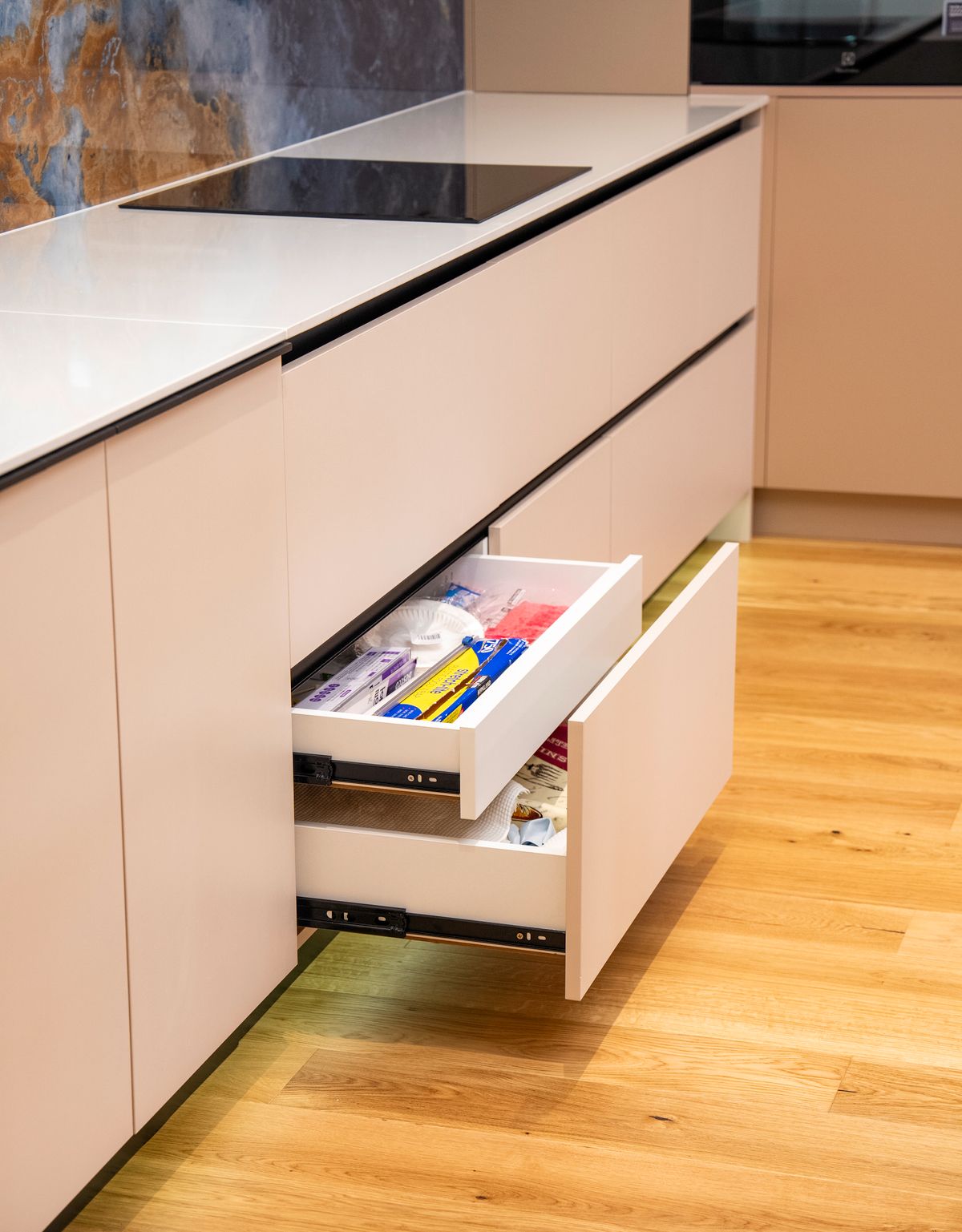
Routed J-pull or rail. Nothing protrudes and the line stays clean, but the lip collects dust and needs wiping into rather than over.

Push-catch. The quietest face of all — and every opening is a press on the door front, so marks gather in one band on dark matt finishes.

Try each one with wet hands and a full drawer before deciding on looks alone.
03

The cabinetry asks the question the benchtop answers

Colour depth is where the three surfaces meet. A very dark matt door will show dust and fingerprints along its opening edge, particularly where there is no handle to take the contact. A mid-tone door in a satin finish absorbs daily use far more quietly and leaves room for a more expressive benchtop or splashback behind it.
Settle the cabinetry first and the other two become answers rather than competing proposals: a heavily veined stone reads as excess against a busy door, and as relief against a plain one. The place to test all three together is the design stage, on samples seen in your own light, not on site once the joinery has been made.